scoresense
Frequently Asked Questions
About ScoreSense
Is ScoreSense legitimate?
Yes. ScoreSense is a legitimate credit monitoring service operated by One Technologies, LLC, a company headquartered in Richardson, Texas. The company provides real credit scores and full credit reports from all three major credit bureaus — Equifax, Experian, and TransUnion — along with daily monitoring and up to $1 million in identity theft insurance underwritten by subsidiaries of AIG.
ScoreSense has been featured in USA Today, Yahoo Finance, MarketWatch, and NBC News, and holds a 4-star rating on Google. Millions of members have used ScoreSense to monitor their credit.
Like any financial product, ScoreSense has a history that prospective customers should be aware of. See the question below about our 2014 FTC settlement for full details. If you have questions before signing up, our credit specialists are available by phone at 1-800-972-7204 or via chat.
Is ScoreSense safe? How is my personal data protected?
ScoreSense uses 128-bit SSL (Secure Sockets Layer) encryption to protect all data transmitted between your browser and our servers — the same standard used by banks and other financial institutions. Your credit information is accessed directly from the three bureaus and displayed within your secure, encrypted account.
ScoreSense does not sell your personal information. For full details, see our Privacy Policy and Terms and Conditions. If you have a specific concern about data handling, contact Customer Care directly at 1-800-972-7204.
Membership
Why does my bank or credit card statement say "OTL*ScoreSense"?
"OTL*ScoreSense" is the billing descriptor ScoreSense uses for all membership charges. OTL stands for One Technologies, LLC, the company that operates ScoreSense.
If you see this charge and don't recognize it, or if you'd like to cancel your membership, contact our Customer Care team right away:
- Phone: 1-800-972-7204
- Hours: Monday–Friday 8 AM–8 PM CST | Saturday 8 AM–5 PM CST | Sunday Noon–6 PM CST
To process your request quickly, please have your ScoreSense Member ID (found in your Welcome email), full name, and the address used when you registered.
How can I cancel my membership?
You can cancel your ScoreSense membership at any time with no further charges after cancellation is confirmed.
To cancel online: Online cancellation is available in certain states. Log in to your ScoreSense account and go to your account settings to see if this option is available to you.
To cancel by chat: If online cancellation is not available in your state, you can initiate cancellation through the chat function in your account.
To cancel by phone: Call 1-800-972-7204 and have the following ready to speed up the process:
- Your ScoreSense Member ID (in your Welcome email)
- Your full name
- The physical address on your account
Customer Care hours: Monday–Friday 8 AM–8 PM CST | Saturday 8 AM–5 PM CST | Sunday Noon–6 PM CST.
After your cancellation is confirmed, no additional charges will be made.
Does ScoreSense offer a free trial?
ScoreSense offers introductory trial access so you can explore the service before committing to full membership. The trial terms, including pricing, duration, and what happens at the end of the trial period, are displayed clearly during signup before you complete your enrollment.
If you have questions about pricing or billing before you sign up, our Customer Care agents are available at 1-800-972-7204.
What happens to my account after I cancel?
Once your cancellation is confirmed, you will continue to have access to our product until your monthly membership or trial period ends and no further charges are made to your payment method.
Your credit reports and scores remain on file with the three bureaus regardless of your ScoreSense membership — ScoreSense is a monitoring product and does not affect what the bureaus store about you.
To reactivate your membership, you will need to re-sign up for our product.
How can I contact Customer Care?
Phone: 1-800-972-7204
Chat: Available through your ScoreSense account dashboard
Hours:
- Monday–Friday: 8 AM–8 PM CST
- Saturday: 8 AM–5 PM CST
- Sunday: Noon–6 PM CST
I cancelled my membership, how can I reactivate it?
Reactivating a cancelled membership is simple. Just call us at 1-800-972-7204. (Monday through Friday 8 AM – 8 PM CST, Saturday 8 AM – 5 PM CST, or Sunday Noon – 6 PM CST).
Is this site secure?
Your security is our top priority. ScoreSense is encrypted using 128-bit SSL (Secure Sockets Layer) technology.
I signed up for an account, now what?
As a ScoreSense member, you are able to choose options that will allow you to access your credit reports and scores as often as you like, dispute errors on your credit report, view threats we have detected to your identity, see details of the sex offenders living near you and more. Start at the ScoreSense Dashboard where you have easy access to all of the ScoreSense features. Look for the “?” icons and “Learn More” links to help you get the most out of your membership.
I never received my Welcome email from ScoreSense. What should I do?
Within 24 hours after signing up with ScoreSense, you should receive a Welcome email containing important membership information. If you did not receive this important email, check your Spam folder and make sure to add customercare@email.scoresense.com to your address book. Also, visit your account page to ensure we have your correct address on file.
Does ScoreSense offer a free trial?
ScoreSense offers introductory trial access so you can explore the service before committing to full membership. The trial terms, including pricing, duration, and what happens at the end of the trial period, are displayed clearly during signup before you complete your enrollment.
If you have questions about pricing or billing before you sign up, our Customer Care agents are available at 1-800-972-7204.
What happens to my account after I cancel?
Once your cancellation is confirmed, you will continue to have access to our product until your monthly membership or trial period ends and no further charges are made to your payment method.
Your credit reports and scores remain on file with the three bureaus regardless of your ScoreSense membership — ScoreSense is a monitoring product and does not affect what the bureaus store about you.
To reactivate your membership, you will need to re-sign up for our product.
Credit Scores & Reports
How accurate are ScoreSense credit scores?
ScoreSense displays real credit score data pulled directly from Equifax, Experian, and TransUnion — the same bureaus lenders check. The data accurately reflects what is in your credit file at the time the report is pulled.
One important distinction: ScoreSense displays VantageScore credit scores, a model developed jointly by the three bureaus. Many mortgage and auto lenders use FICO scores, which are calculated by Fair Isaac Corporation using a different formula. Both models use the same underlying credit data, but they weigh factors differently and will typically produce different numbers — sometimes significantly so.
This is normal and expected across all credit monitoring products, not unique to ScoreSense. The value of tracking your ScoreSense scores is spotting trends, catching errors and fraud early, and understanding which factors are helping or hurting your credit — not treating the number as identical to what a specific lender will see.
Why are my three credit scores different from each other?
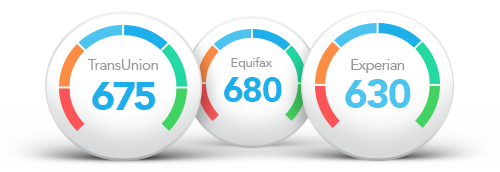
It is completely normal for your Equifax, Experian, and TransUnion scores to differ — sometimes by 20 to 50 points or more. There are two main reasons:
Not all lenders report to all three bureaus. A credit card company might only report your account to one bureau, so it may not appear on the other two reports at all, creating a score difference.
Timing of updates varies. Even when lenders report to all three, they may do so at different times during the month, so one bureau may have a more recent balance or payment on record than another.
This is why having access to all three credit reports matters. Lenders make decisions based on what's in your credit file, and that information can vary across bureaus. Reviewing all three reports lets you verify that the data lenders see is accurate, catch any errors before you apply, and make sure nothing unexpected is working against you.
How often does ScoreSense update my credit scores?
ScoreSense prepares a new credit score and report update from all three bureaus — Equifax, Experian, and TransUnion — once per month. To get your updated scores, log in to your account and pull the latest update. If you don't log in during a given month, that month's data will not be added to your ScoreTracker history, so logging in regularly is the best way to keep your score timeline complete.
In addition to monthly score and report updates, ScoreSense monitors your Experian credit report daily and sends an alert whenever a change is detected: a new account, a new inquiry, an address change, a delinquency, or other activity. You do not have to wait for your monthly update to learn if something has changed.
What credit score model does ScoreSense use?
ScoreSense uses VantageScore 3.0, a credit scoring model developed jointly by Equifax, Experian, and TransUnion. VantageScore 3.0 uses a 300–850 range. Most FICO scores also use a 300–850 range, though some FICO models use a wider range.
Many lenders, particularly for mortgages, use FICO scores. This means the score you see in ScoreSense may differ from the score a lender pulls when you apply for credit. Both are based on the same underlying credit report data, so positive credit habits, like paying on time and keeping balances low, will work in your favor across scoring models.
Will checking my own credit hurt my credit scores?
No. Checking your own credit scores and reports — including through ScoreSense — does not affect your credit scores. These are called "soft inquiries" and are only visible to you, not to lenders.
Hard inquiries, which do affect your score, only occur when a lender pulls your credit as part of an application for a loan or credit card. Monitoring your credit with ScoreSense generates no hard inquiry and has no impact on your scores.
What is a good credit score?
Different lenders set their own thresholds, but generally speaking:
|
Range |
Category |
|
810–850 |
Excellent |
|
750–809 |
Great |
|
670–749 |
Good |
|
560–669 |
Fair |
|
500–559 |
Poor |
|
300–499 |
Very Poor |
Scores above 720 typically qualify for the most competitive interest rates on mortgages, auto loans, and credit cards.
Keep in mind that where your score falls depends on context. ScoreSense's ScoreTracker shows how your scores compare to national averages, your age group, and your state — so you can see not just your number, but how you stand relative to other consumers with similar profiles.
ScoreSense Features
What is ScoreCast? / How accurate are the ScoreCast simulations?
ScoreCast is an interactive simulator that lets you model how specific financial actions might affect your credit score, such as paying off a balance, opening a new account, or missing a payment.
Important: ScoreCast is designed to provide a general approximation based on hypothetical scenarios. Your actual credit scores are not guaranteed to change as the simulation suggests, even if you follow the scenario precisely. Use ScoreCast to understand directional impact and inform decisions, not as a prediction of an exact score change.
You can run as many simulations as you like each month. Simulations have no impact on your actual credit scores and are not saved or stored.
What is ScoreTracker?
ScoreTracker charts your credit scores from all three bureaus over a 12-month period so you can see how your scores have moved over time.
Can I access ScoreSense on my phone?
Yes. The ScoreSense app is available for both iOS (App Store) and Android (Google Play). The app gives you access to your credit scores, reports, and alerts from your mobile device.
What does ScoreSense's $1 million identity theft insurance cover?
ScoreSense members can add up to $1 million in identity theft insurance as an upgrade to their membership. Coverage is underwritten by subsidiaries of American International Group, Inc. (AIG) under a master policy issued to One Technologies, LLC.
Coverage includes reimbursement for the following costs resulting from a stolen identity event:
- Re-filing fees for loans or credit applications rejected due to identity theft
- Notary fees, postage, and long-distance calls made to report the event or correct your records
- Up to six credit reports from established bureaus within 12 months of discovering the theft
- Travel expenses incurred while correcting your records
- Lost wages (up to $1,000 per week for up to four weeks)
- Elder care or child care costs incurred while resolving the theft
- An initial legal consultation (up to $1,000)
- Legal defense fees for civil or criminal matters resulting from the stolen identity event
- Unauthorized electronic fund transfer reimbursement
The aggregate coverage limit is $1,000,000 per policy period with a $0 deductible. Coverage applies to events that occur and are reported while your membership is active. Events must be reported within six months of discovery.
For full terms, conditions, and exclusions, review the coverage summary. Coverage may not be available in all jurisdictions.
What is the difference between credit monitoring and identity theft protection?
Credit monitoring tracks changes to your credit reports, new accounts, new inquiries, balance changes, delinquencies, and alerts you when something changes. It helps you catch errors and spot signs of fraud quickly. Credit monitoring is included with your ScoreSense membership.
Identity theft protection goes further, monitoring places your credit report doesn't cover: the dark web, black market sites, social security number usage, criminal records filed in your name, and other channels where stolen personal information is bought and sold.
Identity theft monitoring is available as an upgrade to your ScoreSense membership. Contact Customer Care at 1-800-972-7204 to learn more.
What does ScoreSense monitor for identity theft?
ScoreSense members who add identity theft monitoring as an upgrade can have their personal information scanned beyond their credit reports, including:
- Dark web and black market site activity involving your personal information
- Social Security number exposure
- Criminal history records filed in your name
- Fraud alerts and other indicators of identity compromise
When a threat is detected, you'll receive an alert so you can take action quickly. To add identity theft monitoring to your membership, contact Customer Care at 1-800-972-7204.
What features are available with my membership?
- Unlimited access to your credit scores and reports updated monthly by TransUnion, Equifax and Experian.
- Credit Monitoring & Alerts notifies you of changes on your credit report.
- ScoreCast™ helps you understand how certain financial actions can potentially impact your scores.
- ScoreTracker™ enables you to chart your scores’ progress each month.
- The Dispute Center outlines the steps for addressing errors on your credit reports with all three bureaus.
- The Learning Center has more than 100 articles on credit.
- ScoreSense App allows you to access your scores and reports from mobile devices.
- Up to $1,000,000 Identity Theft Insurance helps with the cost of restoring your credit profile should identity thieves strike.
Where can I see my credit reports and scores?
Simply log in to your ScoreSense account to see your most recent scores and full credit reports.
How does credit monitoring work?
We monitor your credit report for activity that could affect your scores – or indicate possible identity theft – and notify you with a Credit Alert email. Alerts may be related to: changes in personal information, delinquencies added, new accounts opened, inquiries into your credit, and other actions that may pose a threat.
What should I do if I receive a credit alert?
The right action depends on the type of alert. Here is what to do for the most common ones:
New inquiry: A lender pulled your credit. If you applied for credit recently, this is expected. If you don't recognize it, contact that lender directly to ask about the inquiry.
New account opened: If you opened a new account, no action needed. If you didn't, contact the creditor immediately and consider placing a fraud alert or credit freeze.
Address change: If you didn't change your address, this can indicate someone is attempting to redirect your mail. Contact the bureau to dispute the change and consider a fraud alert.
Delinquency added: If accurate, contact your creditor to discuss the account. If inaccurate, use the ScoreSense Dispute Center to file a dispute with the bureau.
General tip: If you suspect identity theft, contact our Customer Care team at 1-800-972-7204 and refer to the Identity Theft Recovery Guide in your member dashboard.
How many scores can I simulate with ScoreCast each month?
You can simulate as many scores as you like each month. Note that the simulations have no impact on your actual credit scores and do not hurt your credit in any way. Your simulations will not be saved or stored and we do ask that you choose one credit reporting agency to simulate.
How accurate are the ScoreCast simulations?
ScoreCast is designed to provide a general approximation of future credit scores based on hypothetical scenarios. Your credit scores are not guaranteed to change as indicated, even if you follow the scenarios precisely.
Credit Basics
Why is it important to check my credit reports and scores?
You should regularly review your credit reports and scores so that you know what to expect when shopping for the best deals on new loans and lines of credit. A good credit score can save you money by helping you qualify for low-interest mortgages, car loans, and credit cards. Lenders are more likely to offer lower interest rates to those with high credit scores, because they signify a history of good credit behavior. Low interest rates mean you pay less in interest each month on your credit cards, cars, home, and personal loans. These savings can mean you pay hundreds or even thousands less to your creditors each year.
Having good credit saves you money even if you aren’t applying for a new loan. It can help you get that great deal on an apartment, that high-paying job you interviewed for, and lower car insurance and life insurance premiums. It can also keep you in the good graces of your existing creditors, making it less likely that they’ll ratchet up your current interest rate.
The key to determining your eligibility for credit is assessing how you’ve handled past credit obligations. Your credit report provides potential lenders, service providers, employers, and other authorized parties with information about your credit history. A deep understanding of your credit report can help you to use credit responsibly and be able to identify errors that may impact your creditworthiness. Since creditors report your credit activity to the reporting agencies frequently (generally monthly), it is important to review your credit reports and scores often. Keep in mind that there are lots of free credit report tools out there, but none of them offers the ability to track, update, and forecast your credit scores.
With ScoreSense Monitoring, you will be alerted to changes in your credit report. To view your changes you may purchase your report and scores for a one-time fee or upgrade your account to ScoreSense Plus for unlimited access to your credit report and scores.
Will checking my own credit hurt my credit scores?
No, checking your own credit reports and scores will not hurt your credit. In fact, you should regularly check your credit to be sure it does not contain potentially harmful errors or fraud. Enrolling in a credit monitoring service like ScoreSense makes it easy to review your latest credit reports each month.
With ScoreSense Monitoring, you will be alerted to changes in your credit report. To view your changes you may purchase your report and scores for a one-time fee or upgrade your account to ScoreSense Plus for unlimited access to your credit report and scores.
What information is on my credit report?
Your credit report contains personal identifying information, account history and current payment status, employment history, public records in your name, and a list of those who have checked your credit (called credit inquiries).
How many credit reports do I have?
Most consumers have three credit reports in their name—one from each credit reporting agency (Experian®, Equifax®, and TransUnion®). ScoreSense provides you access to the information that Equifax®, Experian®, and TransUnion® keeps on file for you. You can refresh your credit report and score with ScoreSense every month.
With ScoreSense Monitoring, you will be alerted to changes in your credit report. To view your changes you may purchase your report and scores for a one-time fee or upgrade your account to ScoreSense Plus for unlimited access to your credit report and scores.
What if I see an error or fraud on my credit report?
Credit reports containing errors can cost you money and time. You should dispute inaccurate information with the credit reporting agencies as soon as you discover it. The ScoreSense Dispute Center offers a step-by-step guide to help you file disputes with Equifax®, Experian®, and TransUnion® . If you are a member and spot signs of identity theft on your credit reports, you can refer to the ScoreSense Identity Theft Recovery Guide.
How are my credit scores calculated?
Your credit scores are based on the information in your credit reports from Equifax®, Experian®, and TransUnion® . The formula used to calculate your credit scores is primarily based on your payment history, level of debt, and length of credit history. The longer you have proven yourself as a creditworthy consumer, the higher your credit scores are likely to be.
What is a good credit score?
Different lenders have different definitions of a “good” credit score. Generally speaking, credit scores greater than 720 will help you qualify for loans with low interest rates. Scores can range from the 300s to the 800s. The better your score, the more likely you are to qualify for a new auto loan, credit card, or mortgage at a competitive interest rate.
ScoreSense categorizes credit scores in the following manner:
| Excellent | 810-850 |
| Great | 750-809 |
| Good | 670-749 |
| Fair | 560-669 |
| Poor | 500-559 |
| Very Poor | 300-499 |
What is credit monitoring?
Credit monitoring will continuously check your credit reports for you, and alert you whenever any changes or additions appear. ScoreSense will send you an alert whenever an organization checks your credit, whenever your personal information changes, when a delinquency or other piece of negative information is added, or if a new account is opened in your name. Credit monitoring is the best way to ensure that you know about fraudulent activity before it wrecks your credit. The sooner you learn that your identity has been stolen, the easier it is to get it back.
Identity theft happens when someone else accesses your personally identifiable information—such as a name, date of birth, or Social Security number, and uses it to obtain goods, services, credit, or false credentials. There are dozens, if not hundreds, of ways that criminals can access personal information and use it to commit crimes. Our learning center provides information to help you better understand the different types of identity fraud that exist, and what you can do to protect yourself.
What is a hard inquiry vs. a soft inquiry?
A hard inquiry occurs when a lender checks your credit as part of an application — for a mortgage, auto loan, credit card, or other credit product. Hard inquiries are visible to other lenders and can lower your credit score by a few points. They typically fall off your credit report after two years.
A soft inquiry occurs when you check your own credit, when a lender pre-screens you for an offer, or when an employer checks your credit. Soft inquiries do not affect your credit score and are not visible to lenders.
Checking your credit with ScoreSense is a soft inquiry and has no impact on your score.
What is a credit freeze and how do I place one?
A credit freeze (also called a security freeze) restricts access to your credit report so that new lenders cannot pull it. This makes it much harder for someone to open new credit accounts in your name, even if they have your personal information.
Freezing your credit is free and does not affect your credit score. You will need to temporarily lift the freeze whenever you apply for new credit yourself.
You must place a freeze separately at each of the three bureaus. ScoreSense's Credit Freeze Center provides step-by-step instructions on how to place a freeze at Equifax, Experian, and TransUnion.
How do I dispute an error on my credit report?
If you find information on your credit report that is inaccurate — an account you don't recognize, an incorrect balance, a payment reported as late that was made on time — you have the right to dispute it with the bureau that is reporting it.
ScoreSense's Dispute Center provides step-by-step instructions to guide you through filing a dispute directly with Equifax, Experian, or TransUnion. ScoreSense does not file disputes on your behalf — the guide walks you through the process so you can submit the dispute yourself. Bureaus are required to investigate disputes, typically within 30 days.
If you see something on your ScoreSense report that you believe indicates identity theft, refer to the Identity Theft Recovery Guide in your member dashboard or call Customer Care at 1-800-972-7204.
What are the factors that affect my credit score?
VantageScore 3.0, the scoring model used by ScoreSense, calculates your credit score using six factors. Here is how each is weighted approximately:
Payment history (40%) — Whether you pay your bills on time. This is the most heavily weighted factor.
Account mix and credit age (21%) — The variety of account types on your report and how long your accounts have been open.
Credit utilization (20%) — How much of your available credit you are using. Lower utilization is better.
Balances and debt (11%) — The total amount you owe across your accounts.
New activity (5%) — Recent applications for new credit and new accounts opened.
Available credit (3%) — The total amount of credit available to you across your open accounts.
ScoreSense's Credit Insights breaks down each of these factors for your Equifax, Experian, and TransUnion reports individually, so you can see exactly where you stand and where to focus.
What's Your Three Credit Scores?
Credit Scores & Reports From All Three Bureaus, Instantly!**