VantageScore vs. FICO Score: What's the Difference, and Which One Matters Most?
 By
By
When a lender pulls your credit, two things determine the score they see: which credit bureau the data comes from, and which scoring model is applied to that data. The two most widely used models are FICO (source here) and VantageScore (source here). They run on the same underlying credit file but score it differently, which is why the same person can see two different numbers in the same week.
This article breaks down how VantageScore 3.0 and FICO compare, why your scores might land 50 points apart, which bureau uses what, and how to think about the model your lender is actually pulling.
The Quick Breakdown
- VantageScore and FICO both use a 300 to 850 range, but they score the same credit file differently and define the tiers (good, fair, poor) at slightly different cutoffs.
- ScoreSense shows your VantageScore 3.0 from all three bureaus: TransUnion, Equifax, and Experian.
- Most mortgage, auto, and credit card lenders pull a FICO model. Most consumer credit-monitoring products show VantageScore. The two can differ by 20 to 100 points on the same credit file.
- VantageScore can score consumers with as little as one month of credit history. FICO requires at least six months. Roughly 30 to 35 million people who are unscorable by FICO can be scored by VantageScore.
- All three bureaus (Experian, TransUnion, Equifax) sell both FICO and VantageScore products. The lender, not the bureau, picks which model is used.
A Brief History of the Two Models
VantageScore was launched in 2006 by the three credit bureaus (Equifax, Experian, and TransUnion) as an alternative model designed to score more consumers and produce more consistent scores across bureaus. VantageScore 4.0 is now the most widely deployed version, though VantageScore 3.0 remains in heavy use across consumer credit-monitoring products, including ScoreSense.
VantageScore Ranges
VantageScore uses a range of 300 to 850. ScoreSense uses VantageScore 3.0 to calculate the scores shown in your dashboard. Here is how the VantageScore 3.0 range breaks down:
- Excellent Credit: 810-850
- Great Credit: 750-809
- Good Credit: 670-749
- Fair Credit: 560-669
- Poor Credit: 500-559
- Very Poor Credit: 300-499
VantageScore 3.0 weighs six factors when calculating your score. In order of impact:
- Payment History
- Account Mix and Credit Age
- Credit Utilization
- Balances and Debt
- New Activity
- Available Credit
This six-factor structure is one of the core differences between VantageScore 3.0 and FICO, which uses a five-factor framework with different labels and weightings.
FICO Score Ranges
Most FICO base scores use a range of 300 to 850, though some industry-specific FICO models (used in mortgage, auto, and bankcard underwriting) extend beyond 850. The most widely used base version is FICO 8. Here is how the standard FICO base range breaks down:
- Exceptional: 800-850
- Very Good: 740-799
- Good: 670-739
- Fair: 580-669
- Poor: 300-579
FICO scores draw on five factors: Payment History (about 35%), Amounts Owed (about 30%), Length of Credit History (about 15%), Credit Mix (about 10%), and New Credit (about 10%).
Where VantageScore and FICO Are Similar
Despite their differences, the two models overlap in the basics:
Score range: Both use 300 to 850 with similar tier labels.
Data source: Both pull from the same underlying credit files at TransUnion, Equifax, and Experian.
Payment history weighs heaviest: In both models, paying on time is the single largest factor in your score. Late payments produce the largest negative impact in either model.
Rate shopping is recognized: Both FICO and VantageScore treat multiple inquiries for the same loan type within a defined window as a single inquiry, so shopping for a mortgage or auto loan does not stack hits on your score.
Soft inquiries do not affect either score: Checking your own credit through ScoreSense or any consumer-facing product is a soft inquiry and does not move either score.
Where VantageScore and FICO Differ
The differences are larger than most consumers realize.
Scoring requirements: FICO requires at least six months of credit history and one account reported in the past six months. VantageScore requires only one month of credit history and one account reported in the past two years. This is why VantageScore can score roughly 30 to 35 million people considered unscorable under FICO.
Factor structure: VantageScore 3.0 uses six weighted factors. FICO uses five. The labels and weightings differ between the two models, so the same change in your credit behavior can affect each score by a different amount.
Rate-shopping window: FICO allows a 45-day rate-shopping window for mortgage, auto, and student loan inquiries. VantageScore allows a 14-day window for the same rate-shopping treatment (source).
Late payment treatment: FICO treats late payments uniformly regardless of account type. VantageScore weighs late mortgage payments more heavily than late credit card or other consumer payments. VantageScore also treats negative information as neutral when a creditor flags an account as affected by a declared natural disaster, while continuing to credit positive payment activity during that window.
Paid collection accounts: Under FICO 8 (still the most widely used FICO model), paid and unpaid collections carry similar weight, so paying off a collection often does not produce a meaningful score change. Under FICO 9, paid collections are ignored entirely. Under VantageScore, paid collections are weighted less heavily than unpaid ones but are not ignored.
Alternative data: VantageScore can incorporate alternative data such as rent, utility, and phone payments when those are reported to the bureaus. FICO base models do not.
Why Your VantageScore and FICO Score Can Differ by 50 Points or More
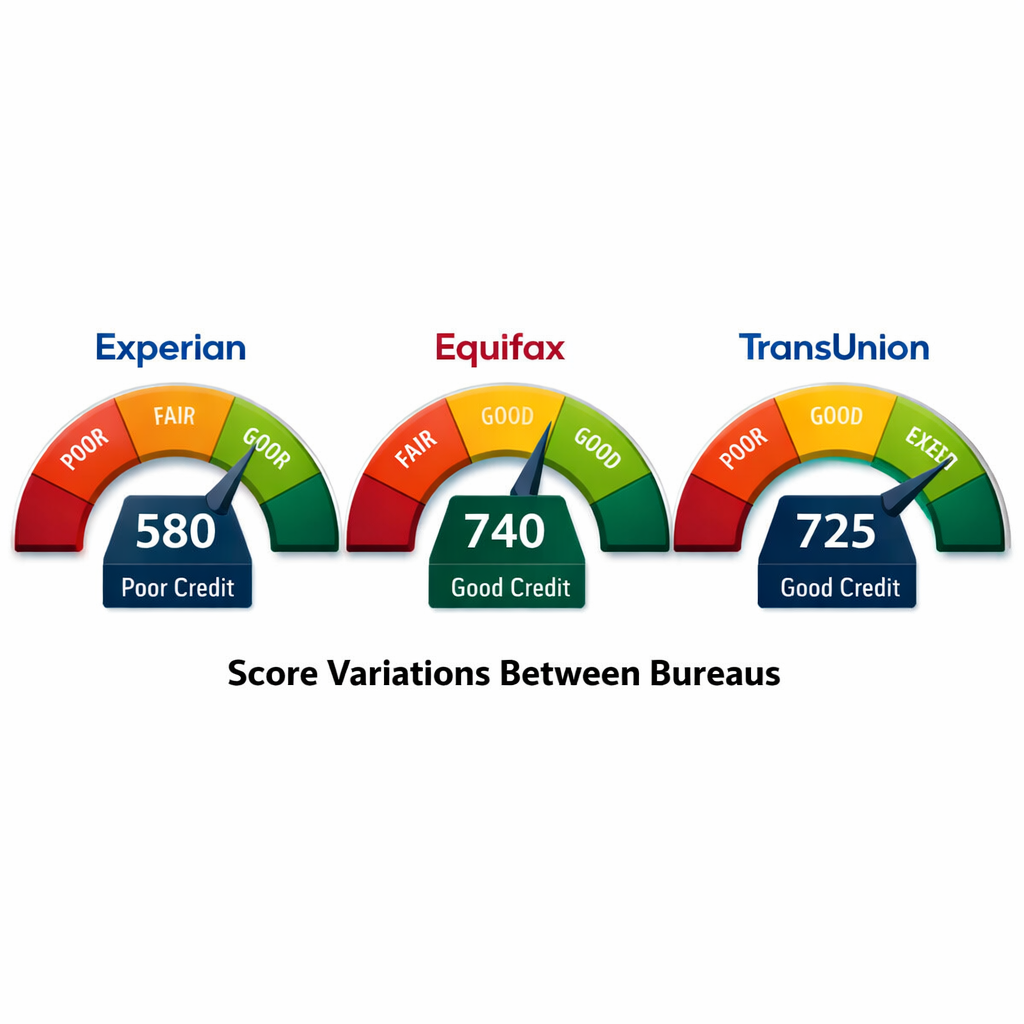
If you check your VantageScore on a consumer product like ScoreSense and your lender quotes a FICO score that is 30, 50, or even 80 points different, the gap is normal. A few reasons:
The models weigh factors differently. A high credit utilization rate (your balances relative to your limits) might pull your VantageScore down by a different amount than your FICO score, because the two models score utilization on different curves.
The data behind the score may differ slightly. Your VantageScore is calculated from the credit file at a specific bureau on the day you check. If the lender pulls a different bureau on a different day, the underlying file may have updates that yours does not (or vice versa).
Different versions exist for both models. Your ScoreSense VantageScore is VantageScore 3.0. Your lender may pull VantageScore 4.0, FICO 8, FICO 9, or an industry-specific FICO model designed for mortgage or auto lending. Each of those versions weighs the file slightly differently.
There is no fixed conversion between VantageScore and FICO. A 720 VantageScore does not translate to a specific FICO score. The right way to compare is not to convert numbers but to view the same credit file in both models when possible, and to address the underlying factors driving each.
Which Credit Bureau Uses VantageScore vs. FICO?
This is one of the most common points of confusion. The bureaus do not pick the scoring model. The lender does.
All three bureaus (Experian, TransUnion, and Equifax) calculate and sell both FICO and VantageScore products. When a lender pulls your credit, they tell the bureau which model and which version to score against. That model is what produces the number the lender sees.
In consumer-facing products, defaults vary:
- Experian sells FICO 8 by default through its direct-to-consumer products and also offers VantageScore.
- TransUnion is the bureau most commonly associated with VantageScore in consumer credit monitoring products.
- Equifax offers both, with FICO 8 typically used in its consumer-facing products.
ScoreSense pulls VantageScore 3.0 from all three bureaus, so you can see how the same model scores your file across Experian, TransUnion, and Equifax.
VantageScore 3.0 vs. FICO 8: A Direct Comparison
These are the two versions a member is most likely to encounter when comparing scores across products.
VantageScore 3.0:
- Range: 300 to 850
- Factors: 6
- Minimum credit history: 1 month
- Rate-shopping window: 14 days
- Paid collections: weighted less than unpaid
- Alternative data: accepted
- Late payment weighting: varies by account type (mortgage hits hardest)
FICO 8:
- Range: 300 to 850
- Factors: 5
- Minimum credit history: 6 months
- Rate-shopping window: 45 days
- Paid collections: weighted similarly to unpaid
- Alternative data: not accepted
- Late payment weighting: uniform across account types
Both versions remain in widespread use, which is why the same member can hold a 740 VantageScore 3.0 and a 690 FICO 8 at the same time on the same credit file.
Is One Score More Accurate Than the Other?
Neither model is more accurate. Both are designed to predict the same thing: the likelihood that a borrower will default on a credit obligation in the next 24 months. Both have been validated against millions of real-world credit outcomes.
The right question is which model your lender is using, since that is the score that will determine your approval and your rate. For most mortgage applications, lenders pull a specific FICO model (typically FICO 2, 4, or 5 depending on the bureau). For most credit card and auto lending decisions, lenders pull FICO 8 or FICO 9. A growing number of lenders accept VantageScore 4.0 in underwriting, particularly in personal lending, but FICO remains dominant in mortgage decisions.
That makes the score on your ScoreSense dashboard most useful as a behavioral indicator. If your VantageScore 3.0 is moving up consistently, the underlying credit behaviors driving it are the same ones that move your FICO score. If your VantageScore drops, your FICO is likely to follow.
Which Score Should You Focus On?
In practice, focus on the credit behaviors that may move both scores in the same direction:
- Pay every account on time, every month
- Keep credit utilization below 30 percent of your limits, and ideally below 10 percent
- Avoid opening multiple new accounts in a short window
- Let your oldest accounts age. Closing them shortens your average credit age in both models
- Address inaccurate information on your reports through the Dispute Center before it has time to compound
The score you see in ScoreSense is your VantageScore 3.0 from each of the three bureaus. The credit data behind that score is the same data your lender will pull. That makes the report itself more important than any single score, because the report is what every model is reading from.
Frequently Asked Questions
Is VantageScore the same as FICO?
No. VantageScore and FICO are two separate scoring models built by different companies. Both use a 300 to 850 range and both pull data from the same three credit bureaus, but they weigh that data differently. The same credit file can produce two different scores depending on which model is used.
Is VantageScore higher than FICO?
Sometimes, but not consistently. On the same credit file, a VantageScore can land higher than a FICO score, lower, or close to identical. The gap depends on the specific factors in the file. People with high credit utilization or thin credit history often see a larger gap between the two scores.
Which credit bureau uses VantageScore vs. FICO?
All three bureaus (Experian, TransUnion, and Equifax) produce both VantageScore and FICO products. The bureau does not pick the model. The lender does, when they request the file. ScoreSense pulls VantageScore 3.0 from all three bureaus.
What is the point difference between FICO and VantageScore?
There is no fixed point difference. On the same credit file, the two models can produce scores within a few points of each other or as much as 80 to 100 points apart. The size of the gap depends on which specific factors are present in the file and how heavily each model weighs them.
Can you convert a VantageScore to a FICO score?
No. There is no formula or conversion table that translates a VantageScore into a FICO score, because the two models use different inputs and weightings. The right way to compare is to view both scores on the same credit file when possible, rather than try to convert one to the other.
Is VantageScore or FICO more accurate?
Neither is more accurate. Both are statistical models designed to predict default risk over the next 24 months. The score that matters most in any given situation is the one the lender is actually pulling.
Why is my VantageScore higher than my FICO score?
A VantageScore can run higher than a FICO score on the same file when the model weighs your strengths more heavily, or when it credits you for factors FICO does not consider (such as alternative data from rent or utility payments reported to the bureaus). Thin or new credit files often see larger gaps because the two models handle limited data differently.
Which scoring model do lenders use?
Most mortgage lenders pull a specific FICO model. Most credit card and auto lenders pull FICO 8 or FICO 9. A growing number of lenders accept VantageScore 4.0, particularly in personal lending. The exact model varies by lender and loan type, so the only way to know for certain is to ask before you apply. It is also worth noting that many lenders have developed their own proprietary scoring models in partnership with FICO, and those custom models are not publicly available.
Why Monitoring Your Scores and Reports Matters
The score on the screen is a snapshot. The credit reports behind that score are the full record. Because creditors report to the three bureaus independently, a missed payment, charge-off, or new collection can show up on one report and not another. Knowing only one bureau's number leaves you exposed to whatever is happening on the other two.
ScoreSense gives you access to your credit scores and reports from all three bureaus: TransUnion, Equifax, and Experian. ScoreSense uses VantageScore 3.0 across all three, so you can see how the same model reads your file at each bureau. ScoreTracker shows how those three scores move over time, which makes trends and recovery patterns visible rather than only showing up in hindsight. ScoreCast helps you see how a specific decision (paying down a card, closing an account, opening a new line) may impact your scores before you act.
If something changes on your Experian report, you will receive an alert through Experian-based credit monitoring. Combined with three-bureau visibility on your reports, that gives you the data lenders are reading from, in time to address it.